
3Sum Closest
The target does not identify the winning triplet. It tells each pointer which direction is still worth exploring.

3Sum Closest
Given an integer array and a target, choose three values from distinct indices whose sum is closest to the target, and return that sum.
Constraints
- 3 <= nums.length <= 500
- -1000 <= nums[i] <= 1000
- -10^4 <= target <= 10^4
Important details
- The three selected indices must be distinct.
- Each input is guaranteed to have exactly one closest-sum result.
Key topics
The target does not identify the winning triplet. It tells each pointer which direction is still worth exploring.
The 3Sum Closest solution is to sort the array, fix one value, scan the remaining suffix with two pointers, and preserve the closest sum found so far. The direct search is cubic; the sorted scan reduces it to quadratic time. The durable skill is not memorizing “sort plus two pointers.” It is deriving pointer movement from the current sum’s relationship to the target.
Read the Contract First
You receive an integer array nums and an integer target. Choose three values from distinct indices and return their sum—the sum itself, not the values or their positions. The problem guarantees a unique closest-sum result.
For example:
nums = [-1, 2, 1, -4]
target = 1
answer = 2
The triplet [-1, 2, 1] produces 2, which is one unit from the target.
Duplicate values are allowed when they occupy different indices. Three zeroes therefore form a valid triplet in:
nums = [0, 0, 0]
The contract is about indices, not a set of distinct values. That distinction determines the pointer boundaries and means we do not need triplet-deduplication logic.
Start With the Cubic Baseline
The straightforward solution enumerates every increasing index triple:
for i in range(n - 2):
    for j in range(i + 1, n - 1):
        for k in range(j + 1, n):
            current_sum = nums[i] + nums[j] + nums[k]
Because i < j < k, every candidate uses distinct indices. For each sum, keep the candidate with the smallest distance from target:
distance = abs(current_sum - target)

if distance < abs(best_sum - target):
    best_sum = current_sum
This baseline costs O(n³) time and O(1) auxiliary space apart from loop variables. It is still valuable: the implementation is easy to trust and can act as a correctness oracle for testing the optimized version on small random inputs.
The bottleneck is the third loop. We want to remove one dimension of enumeration without losing the ability to compare every potentially useful candidate.
Sort, Fix One Value, and Scan the Rest
Sort the array in ascending order:
[-1, 2, 1, -4] -> [-4, -1, 1, 2]
Now fix nums[i] as the first value. The other two values must come from the suffix beginning at i + 1:
left = i + 1
right = n - 1
The current candidate is:
current_sum = nums[i] + nums[left] + nums[right]
Sorting gives the pair search a directional structure:
- Moving
leftrightward increases or preservesnums[left]. - Moving
rightleftward decreases or preservesnums[right].
For a fixed i, imagine a grid of candidate pairs. Rows are left indices, increasing as you move downward. Columns are right indices, increasing as you move to the right. Only the triangular cells with left < right are legal. Moving down tends to increase the sum; moving left tends to decrease it.
That grid is the leverage. We can walk its boundary instead of visiting every cell—but only if we can prove which row or column segment is already dominated.
Derive the Pointer Movement
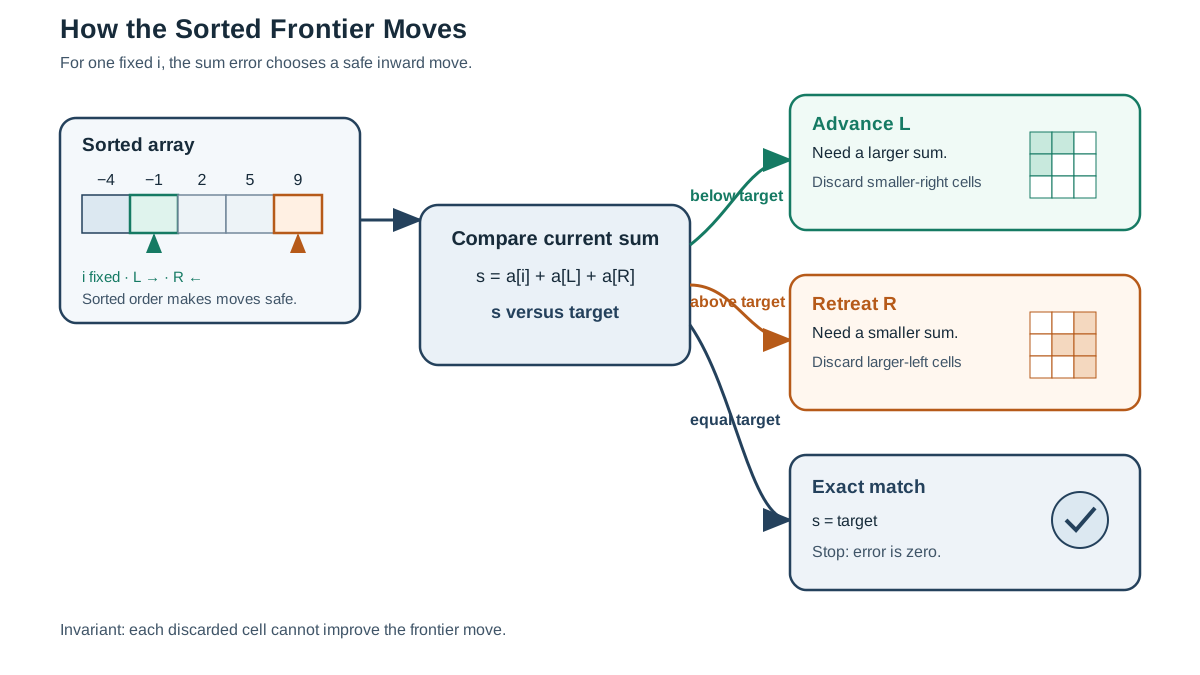
Let the current error be:
error = current_sum - target
The sign of that error determines which pointer can move the sum toward the target. The proof is local: evaluate one cell, identify a whole dominated segment in the pair grid, then move to the boundary of the remaining candidates.
When the sum is too small
Suppose the evaluated cell is (left, right) and:
current_sum < target
Look across the current left row toward smaller right columns. For every r < right, sorting gives nums[r] <= nums[right], so:
nums[i] + nums[left] + nums[r] <= current_sum < target
Those cells are no closer to the target than the cell we just evaluated. The entire row segment to the left of (left, right) is dominated and can be discarded.
The next useful move is therefore to advance left:
left += 1
That moves to the next row, where nums[left] is larger and the sum can increase. The current right column remains available because a larger left value paired with that right endpoint may get closer to the target. Any cells to the right of the evaluated cell have already been excluded by the scan history or do not exist when right starts at the end of the array.
When the sum is too large
Now suppose the evaluated cell is (left, right) and:
current_sum > target
Look down the current right column toward larger left rows. For every l > left, sorting gives nums[l] >= nums[left], so:
nums[i] + nums[l] + nums[right] >= current_sum > target
Those cells are no closer to the target than the cell we just evaluated. The entire column segment below (left, right) is dominated and can be discarded.
The next useful move is therefore to decrease right:
right -= 1
That moves to the previous column, where nums[right] is smaller and the sum can decrease. The current left row remains available because a smaller right value paired with that left endpoint may get closer to the target. Any cells below the evaluated cell have just been proved useless.
The two cases are mirror images: a below-target cell discards its smaller-right row segment and moves down to a larger left; an above-target cell discards its larger-left column segment and moves left to a smaller right. The exact row or column proof matters more than the slogan “move toward the target.”
When the sum matches
If current_sum == target, the distance is zero. No result can improve on zero, so return immediately.
Frontier invariant: For a fixed
i,leftandrightbound the still-relevant frontier of the sorted pair grid. Before each move, record the current cell. If its sum is below the target, the smaller-rightsegment in its row is dominated andleftadvances. If its sum is above the target, the larger-leftsegment in its column is dominated andrightdecreases. Every discarded segment is no closer than the evaluated cell.
The invariant explains both progress and safety: one pointer moves inward on every iteration, and the move removes only candidates whose sorted relationship to the current cell proves they cannot improve the objective.
Preserve the Best Sum Globally
The current sum is only one point in the search. A better result may have appeared under an earlier fixed value, so maintain best_sum across every outer iteration.
Initialize it from a valid triplet rather than from 0:
best_sum = nums[0] + nums[1] + nums[2]
Zero has no special status. The closest sum can be negative, positive, or on either side of the target.
At every visited state:
if abs(current_sum - target) < abs(best_sum - target):
    best_sum = current_sum
The strict comparison is appropriate because the problem guarantees a unique answer. A related problem could require a tie-break rule, but that rule must come from its contract rather than from habit.
Dry Run: Follow the State
Use:
nums = [-1, 2, 1, -4]
target = 1
After sorting:
nums = [-4, -1, 1, 2]
Initialize:
best_sum = -4 + -1 + 1 = -4
For i = 0, the fixed value is -4:
left = 1  -> -1
right = 3 -> 2
current_sum = -4 + -1 + 2 = -3
The sum is too small. In the current left row, smaller right columns can only make the sum smaller, so discard that dominated row segment and advance left:
left = 2  -> 1
right = 3 -> 2
current_sum = -4 + 1 + 2 = -1
This is still below the target. The pointers meet, so this outer iteration ends. The best sum is now -1, at distance 2 from the target.
For i = 1, the fixed value is -1:
left = 2  -> 1
right = 3 -> 2
current_sum = -1 + 1 + 2 = 2
Its distance is 1, so best_sum becomes 2. The sum is too large; larger left rows in the current right column would only increase the sum, so decrease right. The pointers meet and the scan ends.
Return 2.
The useful detail is that the best answer appears under the later outer index. The inner scan finds the best candidate for one fixed value, not necessarily the best triplet globally. That is why best_sum must survive every outer iteration.
With nums = [0, 0, 0] and target = 1, the only valid triplet produces 0. The loop records it, moves a pointer, and terminates when left and right meet.
Python Implementation
def three_sum_closest(nums: list[int], target: int) -> int:
    nums.sort()
    n = len(nums)

    best_sum = nums[0] + nums[1] + nums[2]

    for i in range(n - 2):
        left = i + 1
        right = n - 1

        while left < right:
            current_sum = nums[i] + nums[left] + nums[right]

            if abs(current_sum - target) < abs(best_sum - target):
                best_sum = current_sum

            if current_sum == target:
                return current_sum
            elif current_sum < target:
                left += 1
            else:
                right -= 1

    return best_sum
Each variable has a specific obligation:
ichooses the fixed first index.leftandrightchoose two later, distinct indices.current_sumis the state currently being evaluated.best_sumstores the closest result found across all evaluated frontier states.
The control flow mirrors the derivation: calculate, preserve an improvement, stop on an exact match, then move according to the sign of the error.
This implementation mutates nums because nums.sort() sorts in place. If the caller's order must remain unchanged, sort a copy instead:
values = sorted(nums)
Skipping duplicate values for i is optional here. It can reduce repeated work when many values are equal, but it is not required for correctness because the goal is one sum, not a list of unique triplets. Add deduplication only when you can name the obligation it serves.
Correctness and Complexity
The outer loop uses range(n - 2), so it stops at the last index that leaves two values after i. The inner pointers begin at i + 1 and n - 1, and the loop runs only while left < right. Every evaluated state therefore satisfies:
i < left < right
and uses distinct indices.
For a fixed i, consider an evaluated pair (left, right).
- If its sum is below
target, every pair(left, r)withr < righthas a sum no larger than the current sum. Those cells are even farther below the target, so discarding that row segment and advancingleftis safe. - If its sum is above
target, every pair(l, right)withl > lefthas a sum no smaller than the current sum. Those cells are even farther above the target, so discarding that column segment and decreasingrightis safe. - If its sum equals
target, the distance is already zero and the search can stop.
Thus each move discards only the row or column segment proven no closer by fixed-coordinate monotonicity. The algorithm records the current frontier state before moving, and best_sum retains the closest recorded sum across every fixed i. When the loops finish, it is the closest valid triplet sum.
Sorting costs O(n log n). For each of the O(n) fixed values, either left or right moves toward the other, so the inner scan costs O(n). Therefore:
- Time:
O(n log n + n²), which simplifies toO(n²). - Auxiliary space:
O(1)beyond the input array under the usual convention that excludes sorting workspace. Python's in-place sort may use additional implementation-managed memory.
Edge Cases and Common Failures
- Exactly three values: The initial triplet is the only candidate.
- All values equal: Equality and pointer termination must still work.
- Duplicate values: Repeated values are valid when their indices are distinct.
- Negative values or targets: Pointer direction comes from
current_sumversustarget, not from the signs of individual values. - Target below every achievable sum: The answer may be the smallest achievable sum.
- Target above every achievable sum: The answer may be the largest achievable sum.
- Exact match: Return after evaluating it.
- Off-by-one errors: Use
range(n - 2), setleft = i + 1, and continue only whileleft < right. - Moving both pointers by default: Move only the pointer whose direction can reduce the current error.
- Bad initialization:
best_sum = 0gives the answer an arbitrary bias and can fail when the closest result is negative. - Input mutation: In-place sorting changes
nums. - Tie handling: The supplied contract guarantees a unique result; do not invent a tie rule.
The transferable move is narrower than “use two pointers”: when sorted coordinates make moving one pointer predictably increase the evaluated sum and moving the other predictably decrease it, fix one coordinate and walk the remaining pair grid's frontier. Reuse the pattern only when you can name the dominated row or column segment that each move removes. The proof earns the optimization; the visual metaphor does not.
Evaluate the state. Preserve the best result. Let the objective decide which pointer moves. That is the reasoning move worth carrying to the next problem.
References
Research updated Sep 5, 2026


