
Populating Next Right Pointers in Each Node II
The queue solution is easy to derive. The constant-space solution comes from reusing the next pointers you are building as the queue for the next level.

Populating Next Right Pointers in Each Node II
Given a binary tree, populate each node's next pointer with the node immediately to its right on the same level, or NULL if there is no such node.
Constraints
- The tree contains 0 to 6000 nodes.
- -100 <= Node.val <= 100
Important details
- All next pointers initially are NULL.
- The tree need not be perfect or complete.
- The follow-up permits only constant extra space, with implicit recursive stack space excluded.
Key topics
The queue solution is easy to derive. The constant-space solution comes from reusing the next pointers you are building as the queue for the next level.
The contract and the key constraint
Each node has the usual binary-tree pointers plus a next pointer:
leftandrightdescribe the tree structure.nextmust point to the node immediately to the right on the same level.- The rightmost node on every level must have
next = None.
The tree can be empty, sparse, or irregular. A node may have only a left child, only a right child, or no children. Node values do not affect the algorithm; only structure and pointer state matter.
The interview constraint is the important part: use constant auxiliary space. The returned root is allowed to be mutated, so the existing next fields are available as output state.
That rules out a queue if we want the follow-up solution. But the queue gives us the correct baseline and exposes the optimization.
Why the queue solution is the right baseline
A level-order traversal processes nodes from left to right, one level at a time. For each level:
- Remove nodes from the queue in order.
- Connect each node to the next node removed from that same level.
- Add the node's non-null children to the queue.
- Leave the final node's
nextasNone.
The queue provides the key invariant:
While processing a level, the queue exposes that level in left-to-right order. Therefore, the next node in the queue is the correct right neighbor.
A Python baseline looks like this:
from collections import deque

def connect_with_queue(root):
    if root is None:
        return None

    queue = deque([root])

    while queue:
        level_size = len(queue)
        previous = None

        for _ in range(level_size):
            current = queue.popleft()

            if previous is not None:
                previous.next = current
            previous = current

            if current.left is not None:
                queue.append(current.left)
            if current.right is not None:
                queue.append(current.right)

        # Explicitly terminate this level.
        previous.next = None

    return root
This runs in O(n) time because every node is processed once. Its auxiliary space is O(w), where w is the maximum width of the tree. In the worst case, w is proportional to n.
The queue stores an entire frontier of nodes. The optimization is to ask whether the tree already contains another representation of that frontier.
It does: the next pointers.
Turn each level into a linked list
After a level has been connected, its nodes form a linked list from left to right:
level_head -> node -> node -> node -> None
So instead of removing current-level nodes from a queue, we can walk across them using current.next.
While scanning that current-level chain, inspect each node's children:
- Append the left child if it exists.
- Append the right child if it exists.
- Continue to the next node through
current.next.
Those children are encountered in exactly the order required for the next level.
A temporary dummy node makes the append operation uniform:
dummy -> first child -> second child -> third child
          ^
       next level head
The dummy node is not part of the tree. It is just a stable anchor before the first real child. Its next field gives us the head of the newly built level without special-casing the first child.
The algorithm maintains two separate chains:
- Read: follow
nextpointers across the current level. - Write: create
nextpointers across the children that form the next level.
That separation is the entire trick. We never need a queue because the current frontier is already a linked list, and we build the next frontier while walking it.
The invariant that makes the rewiring safe
Before every outer-loop iteration, maintain this invariant:
level_headis the leftmost node of the current level, and followingnextfrom it visits every node on that level exactly once, from left to right.
During the scan of that level, maintain a second invariant:
The chain beginning at
dummy.nextcontains exactly the non-null children encountered so far, in their required left-to-right order.tailpoints to the last node in that chain.
Why does appending children in this order produce the correct next level?
- Every child of a current-level node belongs to the next depth.
- The current-level nodes are visited from left to right.
- For each parent, the left child appears before the right child.
Therefore, the sequence
current.left, current.right, next current.left, next current.right, ...
with missing children skipped is exactly the next level from left to right.
At the end of the scan, dummy.next is the next level's head. The algorithm advances level_head to that node and repeats.
The final node in the constructed chain must point to None. A fresh dummy node starts each level with an empty chain, and explicitly setting tail.next = None makes the termination deliberate rather than accidental.
Correctness condition: read the current level through established
nextlinks, append every non-null child once in encounter order, terminate the new chain, then advance to its head.
Dry run on a sparse tree
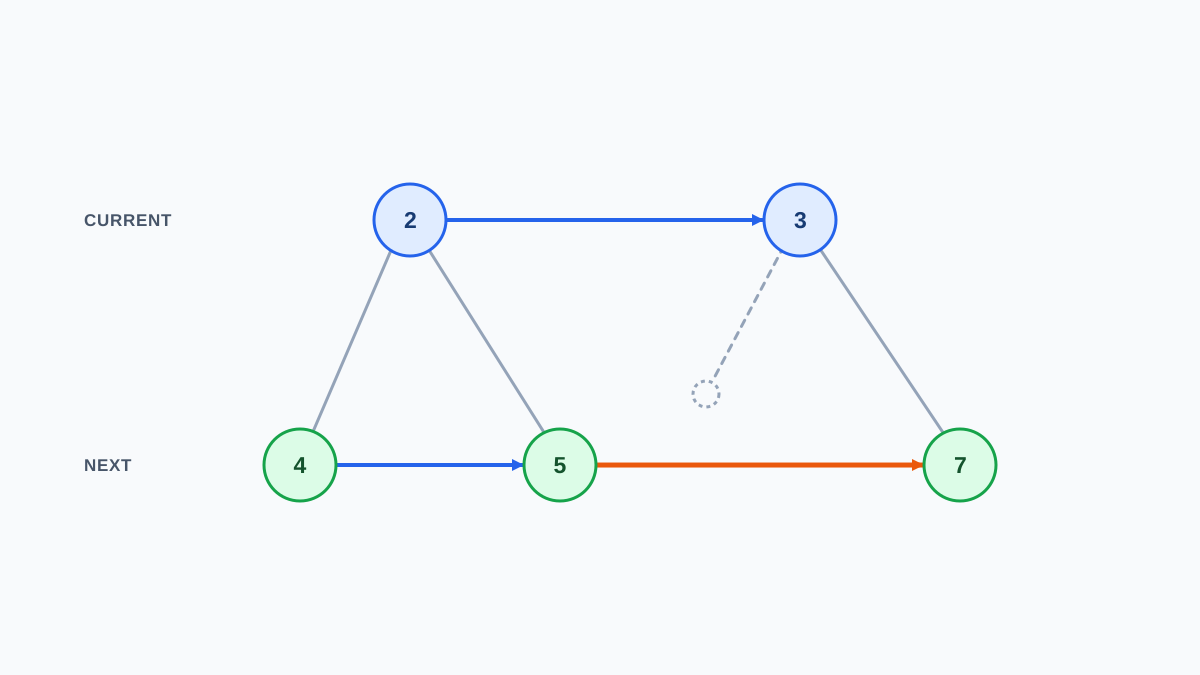
Consider this tree:
        1
       / \
      2   3
     / \   \
    4   5   7
The important connection is on the bottom level. Node 5 must point to node 7, even though they have different parents.
First pass
Initially:
level_head = 1
The current level contains only node 1.
Start with:
dummy -> None
tail = dummy
Scan node 1:
- Append
1.left, which is2. - Append
1.right, which is3.
The constructed chain is now:
dummy -> 2 -> 3 -> None
Advance:
level_head = dummy.next
level_head = 2
The first level has been established:
2 -> 3 -> None
Second pass
Now scan the current level through its next pointers:
2 -> 3 -> None
Start a fresh chain:
dummy -> None
tail = dummy
Process node 2:
- Append
2.left, which is4. - Append
2.right, which is5.
The next-level chain is:
dummy -> 4 -> 5
Move across the current level:
current = current.next
current = 3
Process node 3:
- It has no left child.
- Append its right child,
7.
The chain becomes:
dummy -> 4 -> 5 -> 7 -> None
So the required cross-parent connection appears naturally:
4 -> 5 -> 7 -> None
The algorithm did not calculate a special relationship between 5 and 7. It simply scanned parents left to right and appended their existing children in order.
Compact edge cases
- Empty tree:
level_headisNone; returnNone. - Single node: the root has no children, so no new level is created. Its
nextremainsNone. - One-sided chain: each level contains one node, so every
nextpointer remainsNone. - Gaps on a level: missing children are skipped. The next non-null child becomes the neighbor, even when it belongs to a later parent.
This is where solutions based on fixed child positions break. A node's right neighbor is not necessarily its parent's right child, its sibling, or any node with a matching array index.
Populating Next Right Pointers in Each Node II in Python
Assume the platform provides a Node class with val, left, right, and next fields.
from typing import Optional

class Solution:
    def connect(self, root: Optional["Node"]) -> Optional["Node"]:
        level_head = root

        while level_head is not None:
            # Temporary anchor for the next level.
            dummy = Node(0)
            tail = dummy

            # Walk the current level through its established next links.
            current = level_head

            while current is not None:
                if current.left is not None:
                    tail.next = current.left
                    tail = tail.next

                if current.right is not None:
                    tail.next = current.right
                    tail = tail.next

                current = current.next

            # Make the end of the new level explicit.
            tail.next = None

            # Begin the next outer-loop pass at the new level's head.
            level_head = dummy.next

        return root
The state variables each serve a specific obligation:
level_headidentifies the first node of the level being scanned.currentwalks that level throughnext.dummygives the next level a stable starting point.tailmarks where the next non-null child should be attached.
The dummy node is temporary and constant-sized. It does not grow with the tree. The algorithm keeps only a fixed number of references regardless of the tree's width.
The method returns the original root after mutating its next pointers. That matches the output contract: the tree structure remains intact, while each level gains its horizontal links.
Pointer hygiene
The most common implementation errors are small but destructive:
-
Assuming every parent has two children.
Checkleftandrightindependently. -
Connecting a child to its parent's right child.
The correct neighbor may belong to a different parent several positions away. -
Walking the next level while still building it.
During the inner loop, advance withcurrent = current.next. The newly appended children belong to the next level and should not become part of the current scan. -
Forgetting the final terminator.
Settail.next = Noneso the new level ends cleanly. -
Using a queue despite the follow-up requirement.
The queue solution is correct, but it does not satisfy constant auxiliary space. -
Confusing child pointers with
nextpointers.
leftandrightmove down the tree.nextmoves horizontally across one depth.
If you want to debug the implementation, print each completed level by following next from level_head. That makes the hidden state visible. Pointer problems become much easier when you stop imagining the links and inspect the chain they actually formed.
Complexity and the transferable pattern
The algorithm visits each node once while scanning its level. Each node's children are checked a constant number of times, so the total time complexity is:
O(n)
The auxiliary space is:
O(1)
Only fixed pointer variables and one temporary sentinel are used. The tree's next fields are output state reused as traversal state; they are not an additional queue or stack.
The reusable pattern is broader than this one problem:
When a problem asks you to connect nodes across levels, and those connections can expose the current frontier in order, use the established frontier as the queue and build the next frontier in one pass.
In an interview, make the reasoning visible:
- Identify how the current level is represented.
- Define what the current scan guarantees.
- Append children in left-to-right encounter order.
- Terminate the new chain.
- Advance to its head.
- Return the original structure after mutation.
The durable insight is simple: the output links become the traversal mechanism. Once you recognize that a completed level is already a linked list, the constant-space solution stops looking like pointer magic. It becomes a controlled state transition: scan one chain, build the next, repeat.
References
Practice interview patterns more systematically
Use structured problem sets and pattern references to turn isolated solutions into reusable interview judgment.


