
Reverse Nodes in k-Group
Reversing a linked-list segment is easy. Preserving everything on both sides of that segment is the real interview problem.

Reverse Nodes in k-Group
Given the head of a singly linked list and a positive integer k, reverse the nodes in each consecutive group of k nodes and return the modified list. If the final group has fewer than k nodes, leave it unchanged, and change node links rather than node values.
Constraints
- The list contains n nodes, with 1 <= k <= n <= 5000.
- Each node value is between 0 and 1000 inclusive.
Important details
- Only node connections may be changed; node values must not be altered.
- Complete groups are reversed independently in their original group order.
- A trailing group smaller than k remains in its original order.
Key topics
Reversing a linked-list segment is easy. Preserving everything on both sides of that segment is the real interview problem.
Read the Contract Before Touching a Pointer
You receive the head of a singly linked list and a positive integer k. Every complete block of k nodes must be reversed in place.
Three constraints define the solution:
- Change
nextpointers, not node values. - Reverse complete groups independently, preserving the order of the groups.
- Leave a final group of fewer than
knodes unchanged.
For example:
Input:  1 → 2 → 3 → 4 → 5, k = 2
Output: 2 → 1 → 4 → 3 → 5
The nodes themselves remain the same objects. Only their connections change. Copying values into an array, reversing the array, and overwriting node values may produce the same serialized output, but it violates the structural contract.
The harder question is what happens during the first mutation. Once you change a node's next pointer, the original forward path may disappear. If you have not saved the untouched suffix, it is gone from your local view.
That gives us the central rule:
Before changing a link, identify the group predecessor, the group terminus, and the successor after the group.
Everything else follows from that boundary ownership.
Recognize the Bounded-Reversal Pattern
This problem has four recognition cues:
- The list is divided into repeated fixed-size segments.
- Each complete segment undergoes a local reversal.
- A short remainder must remain untouched.
- The mutation must happen through node links with constant auxiliary space.
The standard linked-list reversal primitive is only one part of the problem. The full solution has three separate obligations:
- Detect whether at least
knodes remain. - Reverse exactly those
knodes. - Reconnect the reversed segment to the processed prefix and untouched suffix.
Candidates often combine these obligations too early. That is where pointer bugs start. A clean implementation treats each group as a temporary ownership boundary:
processed prefix | current group of k nodes | untouched suffix
The current iteration may mutate only the middle region. It must preserve a route into the suffix before mutation begins.
A brute-force baseline makes the intended structure clearer. You could collect nodes or values, reverse complete chunks in an auxiliary array, then rebuild or overwrite the list. That costs O(n) additional space and weakens the node-identity guarantee. The in-place solution exploits a simpler fact: a linked list already stores the sequence as pointers, so the reversal can happen directly in those pointers.
Fast and slow pointers are not the primary pattern here. They are useful when the decisive structure involves a midpoint, a cycle, or unequal traversal rates. This problem has none of those. Its decisive structure is fixed-size ownership and boundary preservation.
Name the Pointer Obligations
Use a dummy node before the real head:
dummy → head
The dummy removes the special case where the first group changes the list's head. Every group now has a predecessor that can be rewired in the same way.
For the current group, define:
| Variable | Meaning |
|---|---|
group_prev | Node immediately before the current group |
kth | Last node in the current group |
group_head | First node in the current group |
group_next | First node after the current group |
Before reversal, the structure is:
group_prev → group_head → ... → kth → group_next
After reversal, it must become:
group_prev → kth → ... → group_head → group_next
The original group_head becomes the new tail. That detail does double duty:
- Its
nextpointer must be repaired togroup_next. - It becomes the next
group_prev, because the next group begins after this new tail.
Detection must happen before mutation. Start at group_prev and walk exactly k links. If you cannot reach a kth node, fewer than k nodes remain. Stop immediately. The incomplete suffix is already in the required order.
The most important saved pointer is group_next. The old kth.next link will be overwritten during reversal, so the suffix must be recorded first.
Derive the Iterative Solution
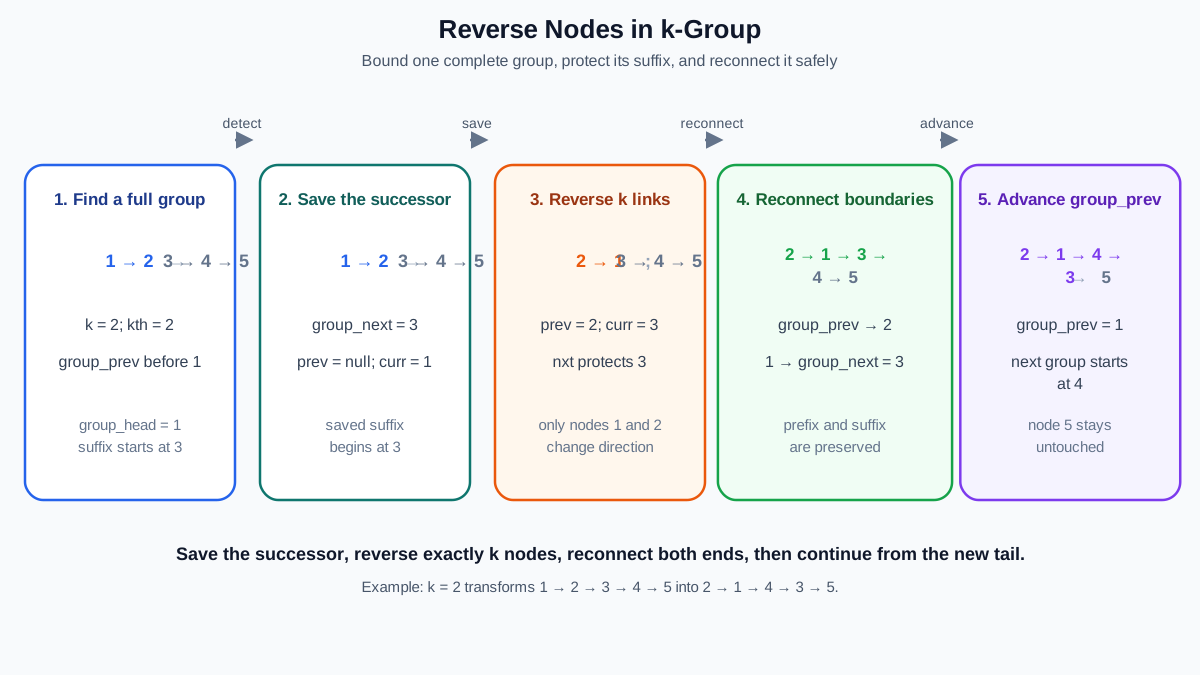
The algorithm follows a fixed sequence.
1. Establish the common predecessor
dummy = ListNode(0, head)
group_prev = dummy
The dummy gives the first group the same shape as every later group.
2. Find the end of a complete group
Walk from group_prev exactly k steps. If the pointer becomes None before completing those steps, return dummy.next. No mutation has occurred in the incomplete suffix.
3. Save the boundaries
Once kth exists:
group_head = group_prev.next
group_next = kth.next
At this point, the current group is still connected to the suffix.
4. Reverse only the group
Initialize:
prev = group_next
curr = group_head
Then reverse until curr reaches group_next.
Starting prev at group_next is a useful implementation choice. It means the original group head—the eventual tail—will point to the suffix as part of the normal reversal loop. There is no separate “repair the tail” operation afterward.
5. Reconnect and advance
After reversal:
kthis the new head of the group.group_headis the new tail.group_prev.nextmust point tokth.group_prevadvances togroup_head.
The loop then starts at the first node after the processed group.
Here is the state transition for 1 → 2 → 3 → 4 → 5 with k = 2:
| Stage | Processed prefix | Current group | Suffix |
|---|---|---|---|
| Start | empty | 1 → 2 | 3 → 4 → 5 |
| After group 1 | 2 → 1 | 3 → 4 | 5 |
| After group 2 | 2 → 1 → 4 → 3 | incomplete 5 | empty |
The result is:
2 → 1 → 4 → 3 → 5
Notice what did not happen: node 5 was never reversed, detached, or temporarily redirected. Detection stopped before mutation.
A recursive formulation is also possible: reverse the first complete group, recursively process the remainder, and connect the old head to the recursive result. That can make the decomposition elegant, but it consumes call-stack space. For this problem, the iterative state machine is preferable in an interview because it exposes the exact boundaries and satisfies the constant-space requirement directly.
Prove Reachability and Progress
A pointer solution is not complete because its output looks correct on one example. We need to know that every original node remains reachable exactly once.
Use this loop invariant:
Before each iteration,
dummy.nextreaches all previously processed complete groups in final order.group_previs the tail of that processed prefix, andgroup_prev.nextbegins the unprocessed suffix in its original order.
The proof has four parts.
Detection preserves an incomplete suffix
Suppose fewer than k nodes remain. The detection walk cannot reach a valid kth node, so the algorithm returns without changing any pointer in the suffix.
The already-processed prefix still ends at group_prev, whose next pointer reaches the suffix. Therefore the incomplete group remains connected and unchanged.
Bounded reversal preserves node identity
For a complete group, the reversal loop processes exactly the nodes from group_head through kth.
On each iteration:
- Save
curr.nextinnxt. - Redirect
curr.nexttoprev. - Move
prevtocurr. - Move
currtonxt.
Because nxt is saved before the mutation, the scan never loses the next node in the group. Because the loop stops when curr is group_next, it never modifies a node outside the group.
Every one of the k original nodes appears once in the reversed chain.
Reconnection restores the global chain
After the reversal loop:
prev = kth
group_head.next = group_next
The local chain is correct. Assigning:
group_prev.next = kth
connects the processed prefix to the reversed group.
The original group head now leads to group_next, so the reversed group also reaches the untouched suffix. No node is stranded.
Advancement guarantees termination
The original group_head is now the tail of the reversed group. Assigning:
group_prev = group_head
moves the boundary strictly forward by k nodes.
Since the list is finite, eventually either all nodes are processed or fewer than k nodes remain. The loop terminates.
By induction over complete groups, the final list contains every original node exactly once, reverses each complete block, preserves the order of the blocks, and leaves a short trailing block unchanged.
That is the k-group pointer invariant: the prefix is final, the current group is bounded, and the suffix has a saved entrance.
Dry-Run the Failure Boundaries
Most pointer implementations survive the ordinary example. They fail at boundaries. Test the boundaries deliberately.
k = 1
Every group contains one node, so the visible list does not change.
The algorithm still has work to do: it must advance group_prev after each group. If it leaves group_prev in place, the same node is detected repeatedly and the loop never progresses.
With k = 1, the reversal loop performs one link assignment per node, restoring the same connection.
Exact multiple of k
For:
1 → 2 → 3 → 4, k = 2
the output is:
2 → 1 → 4 → 3
The final reversed tail must point to None. This is handled by setting prev = group_next, where group_next is None for the last group.
A stale link here can create a cycle, such as 3 → 4 → 3, or accidentally preserve an old forward edge.
Short trailing group
For:
1 → 2 → 3 → 4 → 5, k = 3
the first group becomes:
3 → 2 → 1
Then detection starts at node 1 and finds only 4 → 5. Because the second group is incomplete, the algorithm returns:
3 → 2 → 1 → 4 → 5
The important test is not merely the output values. Verify that no reversal code ran on 4 or 5.
k = n
The entire list is one complete group. Reverse once and ensure the new tail points to None.
Empty and single-node lists
The stated constraints describe a nonempty list with k <= n, but a defensive method can still handle:
head is None- a one-node list
k == 1
These cases should return without error.
Common pointer failures
| Failure | Observable consequence |
|---|---|
Forgetting group_next | The untouched suffix becomes unreachable |
| Reversing before checking group size | The short suffix is reversed incorrectly |
Advancing from kth | The next predecessor boundary is wrong |
Advancing from the old group_prev | The same group can be processed again |
| Connecting the old head to the wrong node | Groups become disconnected or interleaved |
Returning head | The first reversed group is skipped from the result |
| Failing to terminate the last group | A stale link can create a cycle |
For serious validation, inspect structure rather than only serialized values. Track the original node identities and confirm that:
- Every original node is reachable exactly once.
- No cycle exists.
- The final node's
nextisNone. - The short suffix preserves its original order.
- Node values were never assigned.
Implement the Python Solution
Assume the usual ListNode shape, with val and next fields.
class Solution:
    def reverseKGroup(self, head: ListNode | None, k: int) -> ListNode | None:
        if head is None or k <= 1:
            return head

        dummy = ListNode(0, head)
        group_prev = dummy

        while True:
            # Find the kth node without changing any links.
            kth = group_prev
            for _ in range(k):
                kth = kth.next
                if kth is None:
                    # Fewer than k nodes remain; leave them unchanged.
                    return dummy.next

            group_head = group_prev.next
            group_next = kth.next

            # Reverse exactly [group_head, kth].
            # Starting prev at group_next repairs the new tail in-place.
            prev = group_next
            curr = group_head

            while curr is not group_next:
                nxt = curr.next
                curr.next = prev
                prev = curr
                curr = nxt

            # kth is the new head; group_head is the new tail.
            group_prev.next = kth
            group_prev = group_head
Each variable has one job:
group_prevowns the connection from the processed prefix.kthproves that a complete group exists and identifies its end.group_headidentifies the first node and later becomes the new tail.group_nextprotects the untouched suffix.prev,curr, andnxtperform the bounded reversal.
The order of assignments matters. In particular, this line must happen before any reversal:
group_next = kth.next
And this line must happen before advancing:
group_prev.next = kth
Otherwise the processed prefix has no route into the new group head.
If your interview environment does not support the union-type annotation, use the platform's expected signature or remove the annotations. The pointer logic is unchanged.
Complexity and Interview Validation
Let n be the number of nodes.
The algorithm takes O(n) time. Each complete group is scanned once to locate its kth node and then traversed once during reversal. Across all groups, those scans cover the list a constant number of times, so the total work is linear.
The iterative solution uses O(1) auxiliary space:
- A dummy node.
- A fixed number of local pointers.
- No array, set, copied node list, or recursion stack.
The input nodes themselves are not counted as auxiliary space. The dummy node is a constant-sized helper.
A compact validation matrix:
| Case | Expected structural behavior |
|---|---|
k = 1 | Same order; boundary advances |
| Exact multiple | Every group reverses; final tail points to None |
| Short trailing group | Complete prefix reverses; suffix stays unchanged |
k = n | One full-list reversal |
| One node | Same node returned |
| Empty defensive case | None returned |
In an interview, explain the solution in this order:
- State the contract: complete groups reverse, incomplete suffix does not.
- Name the boundary pointers.
- Explain why
group_nextmust be saved before mutation. - Reverse only the bounded segment.
- Reconnect the prefix and suffix.
- State the reachability invariant.
- Give time and space complexity.
- Test
k = 1, an exact multiple, and a short trailing group.
The transferable rule is simple:
Whenever a linked-list problem repeats a local mutation over bounded segments, identify the predecessor, terminal node, and successor before changing any link.
Save the successor. Mutate only the owned segment. Reconnect it. Advance from the node whose new role is guaranteed by the mutation. Then dry-run one complete group and one incomplete group, checking reachability after every assignment.
References
Research updated Sep 7, 2026


