
String to Integer (atoi)
A reliable atoi parser is a small state machine: skip leading spaces, read one optional sign, consume one numeric prefix, and guard every accumulator…

String to Integer (atoi)
Implement conversion of a string to a 32-bit signed integer by processing leading spaces, an optional sign, and the subsequent consecutive decimal digits; stop at the first non-digit and clamp out-of-range results to the 32-bit signed limits.
Constraints
- 0 <= s.length <= 200
- s consists of English letters, digits 0-9, spaces, '+', '-', and '.'.
Important details
- Ignore only leading spaces before interpreting the optional sign.
- If neither sign appears, the value is positive.
- If no digits are read, return 0.
- Parsing stops at the first non-digit after the optional sign and digits.
- Clamp values below -2^31 to -2^31 and values above 2^31 - 1 to 2^31 - 1.
Key topics
A reliable atoi parser is a small state machine: skip leading spaces, read one optional sign, consume one numeric prefix, and guard every accumulator update before it can exceed the 32-bit range.
Read the Contract First
The arithmetic is straightforward. The difficult part is preserving the boundary between the valid numeric prefix and everything that follows it.
The parser must:
- Ignore leading space characters.
- Read at most one optional
+or-. - Consume consecutive decimal digits.
- Stop at the first non-digit.
- Clamp the result to the signed 32-bit range.
The output range is:
[ [-2^{31}, 2^{31}-1] = [-2147483648, 2147483647] ]
A few examples define the boundary more clearly than a paragraph:
| Input | Result | Reason |
|---|---|---|
"" | 0 | There is nothing to parse |
" " | 0 | Only leading spaces exist |
"+" | 0 | A sign without digits produces no number |
" +0012abc" | 12 | Consume digits, then stop at a |
"1337c0d3" | 1337 | The first non-digit terminates parsing |
"0-1" | 0 | The later - cannot restart parsing |
"words and 987" | 0 | The first non-space character is invalid |
"2147483648" | 2147483647 | Positive overflow clamps to the maximum |
"-2147483649" | -2147483648 | Negative overflow clamps to the minimum |
Position matters. Searching for the first digit would incorrectly turn "words 123" into 123. Calling strip() would erase trailing spaces that should terminate the numeric prefix. The parser must follow the contract from left to right rather than normalize the input into a different grammar.
Recognize the Four Parsing Phases
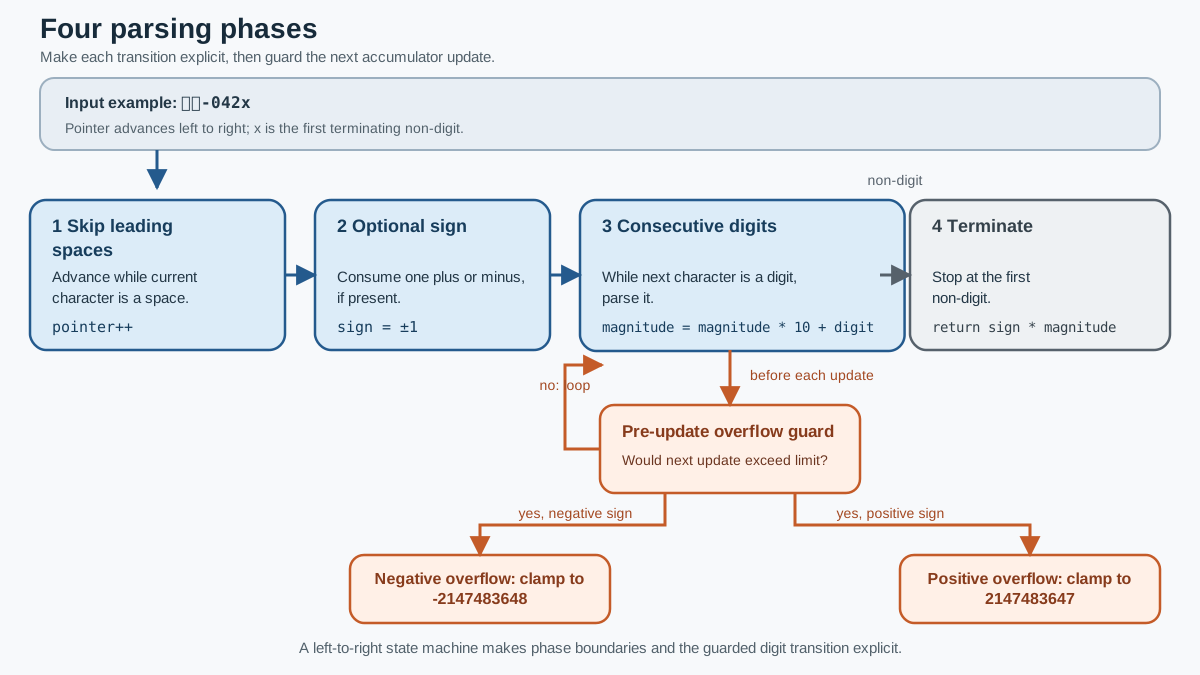
Think of the input as a string parser state machine with four ordered phases. Each phase permits a narrow set of transitions.
1. Skip leading spaces
Advance while the current character is exactly ' '.
This phase can skip:
" 42" -> 42
It cannot search through arbitrary text:
" words 42" -> 0
The contract names the space character specifically, so the implementation should check for ' ' rather than silently accepting every kind of whitespace.
2. Read one optional sign
At the first non-space position, consume one + or - if present.
"-42"  -> -42
"+42"  -> 42
"+-12" -> 0
The sign is meaningful only in this phase. In "0-1", the parser consumes 0, then stops when it reaches -. It does not return to the sign phase.
Store the sign separately from the magnitude. That lets positive and negative input share the same digit-accumulation logic.
3. Consume consecutive digits
For each digit, extend the decimal prefix. If the current magnitude is m and the next digit has value d, the candidate update is:
[ m' = 10m + d ]
Leading zeroes require no special case. They are ordinary digit updates.
The digit phase ends at the first character outside '0' through '9'.
4. Terminate
Termination is an expected parser transition, not an error. Once a non-digit appears after the optional sign and digit prefix, return the value accumulated so far.
For example:
"1337c0d3" -> consume 1, 3, 3, 7; stop at c
" -042x"   -> skip space, read -, consume 0, 4, 2; stop at x
"words 42" -> consume no digits; return 0
The minimal state is:
i: the current positionsign:1or-1magnitude: the digits consumed so farlimit: the largest allowed magnitude for this sign
No has_digit flag is required. If the digit loop consumes nothing, magnitude remains 0, and returning sign * magnitude already produces the required result for "", "+", "-", and other sign-only prefixes. Parsed zero also returns 0; the output does not need to distinguish those histories.
Maintain the Accumulator Invariant
The core invariant is:
After the digit loop has consumed a prefix,
magnitudeequals the base-10 value represented by exactly those consumed digits.
Suppose the parser has consumed "42". The magnitude is 42. Reading 7 appends that digit to the prefix:
[ 42 \times 10 + 7 = 427 ]
For " -042x", the state evolves as follows:
| Consumed part | Sign | Magnitude |
|---|---|---|
| leading space skipped | 1 | 0 |
- consumed | -1 | 0 |
0 consumed | -1 | 0 |
4 consumed | -1 | 4 |
2 consumed | -1 | 42 |
x observed | -1 | 42 |
The final result is -42.
This direct scan is preferable in an interview because every obligation remains visible. A substring-and-conversion solution still has to identify the legal start, optional sign, first terminator, and overflow boundary. It may be shorter, but it hides the mechanism being tested.
Guard Overflow Before the Update
A signed 32-bit integer has asymmetric limits:
- Positive maximum:
2147483647 - Negative minimum:
-2147483648
The negative side has one extra unit of magnitude. Therefore:
positive input: limit = 2147483647
negative input: limit = 2147483648
Before applying:
[ m' = 10m + d ]
check whether m' would exceed limit. Rearranging the inequality gives two cases:
m > limit // 10m == limit // 10andd > limit % 10
So the guard is:
if magnitude > limit // 10:
    overflow

if magnitude == limit // 10 and digit > limit % 10:
    overflow
This is the important implementation move: guard the next state transition, not the state after damage.
Boundary trace
For the positive limit 2147483647:
limit // 10 = 214748364
limit % 10  = 7
When the parser has read 214748364:
- Next digit
7: allowed, producing2147483647 - Next digit
8: rejected before the update, because8 > 7
For the negative limit 2147483648:
limit // 10 = 214748364
limit % 10  = 8
When the parser has read 214748364:
- Next digit
8: allowed, producing2147483648 - Next digit
9: rejected before the update
That one-remainder difference is why the negative limit must be selected before the digit loop.
Python integers do not overflow during multiplication, but the parser still needs this explicit guard. The output contract is 32-bit, and pre-update checking is the reasoning pattern that transfers directly to fixed-width languages.
Implement the One-Pass Parser
def myAtoi(s: str) -> int:
    n = len(s)
    i = 0

    # Phase 1: skip leading spaces
    while i < n and s[i] == " ":
        i += 1

    # Phase 2: read one optional sign
    sign = 1
    if i < n and s[i] in "+-":
        if s[i] == "-":
            sign = -1
        i += 1

    # A negative result may have magnitude 2147483648.
    limit = 2147483648 if sign == -1 else 2147483647

    magnitude = 0

    # Phase 3: consume consecutive decimal digits
    while i < n and "0" <= s[i] <= "9":
        digit = ord(s[i]) - ord("0")

        # Guard the next update before multiplying by 10.
        if (
            magnitude > limit // 10
            or (
                magnitude == limit // 10
                and digit > limit % 10
            )
        ):
            return -limit if sign == -1 else limit

        magnitude = magnitude * 10 + digit
        i += 1

    # Phase 4: stop at the first non-digit.
    # If no digit was consumed, magnitude is still 0.
    return sign * magnitude
The explicit comparison:
"0" <= s[i] <= "9"
matches the problem's decimal alphabet exactly. A broader predicate such as isdigit() may recognize characters outside that narrow grammar. In ordinary application code, that distinction may be acceptable; in an interview parser, explicit behavior is easier to audit.
The code also avoids int(s) and strip() because neither operation represents the required phase boundaries. Built-ins are useful when their semantics match the contract. Here, the contract itself is the algorithm.
Why the State Transitions Are Correct
Each phase preserves a specific condition.
During whitespace skipping, i advances only across leading spaces. It cannot skip letters or search for a later number.
After the sign phase, sign reflects the optional sign immediately following those spaces. If no sign appears, it remains positive. A later sign is never reconsidered.
During the digit phase, the invariant is:
magnitudeis the value of exactly the consecutive digits consumed so far, and it never exceeds the sign-specific limit.
Appending digit d preserves the numeric part of the invariant because decimal concatenation is magnitude * 10 + d. The overflow guard preserves the bound by returning before an invalid update occurs.
Stopping at the first non-digit preserves prefix semantics. The parser returns the longest legal numeric prefix rather than skipping invalid characters and resuming later.
Consider "1337c0d3":
| Character | Action | Magnitude |
|---|---|---|
1 | consume | 1 |
3 | consume | 13 |
3 | consume | 133 |
7 | consume | 1337 |
c | terminate | 1337 |
For "-2147483649", the final digit is where the guard matters:
- The negative limit is
2147483648. - The parser safely consumes through
214748364. - The next digit is
9. - Since
9 > 8, the candidate update is rejected. - The function returns
-2147483648.
The exact boundary is accepted:
"-2147483648"returns-2147483648."-2147483649"clamps to-2147483648."2147483647"returns2147483647."2147483648"clamps to2147483647.
Test the Failure Boundaries
Test groups should target contract obligations rather than merely provide random inputs.
| Test group | Examples | Expected behavior |
|---|---|---|
| Empty and spaces | "", " " | 0 |
| Sign without digits | "+", "-", "+-12" | 0 |
| Valid prefix with text | " +0012abc", "1337c0d3" | 12, 1337 |
| Text before digits | "words and 987" | 0 |
| Internal space | "0 123" | 0 |
| Repeated or late signs | "--5", "0-1" | 0, 0 |
| Punctuation terminator | "12.5" | 12 |
| Leading zeroes | "0000", "-00042" | 0, -42 |
| Exact bounds | "2147483647", "-2147483648" | Same values |
| Positive overflow | "2147483648" | 2147483647 |
| Negative overflow | "-2147483649" | -2147483648 |
Always pair each exact endpoint with the first value beyond it. Endpoints prove that valid values survive. One-step overflow proves that the guard compares the final digit correctly.
Complexity and the Transferable Pattern
Each character is inspected at most once:
- Time:
O(n), wherenis the string length - Auxiliary space:
O(1)
The reusable pattern is state tracking with a guarded invariant:
- Write the legal phases.
- Name the state each phase must maintain.
- Derive the update from the representation.
- Guard the next update before changing state.
- Stop when the next transition is illegal.
That is the durable String to Integer (atoi) solution. The code is short because the state model is small—not because the edge cases disappeared. When an unfamiliar parser appears in an interview, start by naming its phases, then write the invariant that makes each transition safe.
References
Research updated Sep 7, 2026


