
Construct Binary Tree from Preorder and Inorder Traversal
The trap in this problem is stopping at “preorder gives the root.” That identifies one node, but not the boundaries of its children. The real solution is…

Construct Binary Tree from Preorder and Inorder Traversal
Given preorder and inorder integer arrays representing traversals of the same binary tree, construct and return that tree.
Constraints
- 1 <= preorder.length <= 3000.
- inorder.length == preorder.length.
- -3000 <= preorder[i], inorder[i] <= 3000.
- preorder and inorder contain unique values.
- Every value in inorder also appears in preorder.
Important details
- The arrays are guaranteed to be the preorder and inorder traversals of the same tree, respectively.
Key topics
The trap in this problem is stopping at “preorder gives the root.” That identifies one node, but not the boundaries of its children. The real solution is to let inorder define the split and let subtree sizes place those pieces correctly in preorder.
Read the traversal contract first
You receive two valid traversals of the same binary tree:
- Preorder: root, left subtree, right subtree
- Inorder: left subtree, root, right subtree
The values are unique, both arrays have the same length, and every value appears in both arrays. You must construct and return the root of the tree, not return another traversal.
Use the canonical example:
preorder = [3, 9, 20, 15, 7]
inorder  = [9, 3, 15, 20, 7]
The first preorder value is 3, so 3 must be the root. In inorder, 3 appears between [9] and [15, 20, 7]. Therefore:
        3
       / \
      9   20
         /  \
        15   7
That structure is the entire problem in miniature:
- Read the current root from preorder.
- Find that root in inorder.
- Everything before it belongs to the left subtree.
- Everything after it belongs to the right subtree.
- Repeat for both intervals.
The implementation challenge is keeping the preorder and inorder segments aligned without repeatedly copying or scanning arrays.
The key split: root in preorder, boundary in inorder
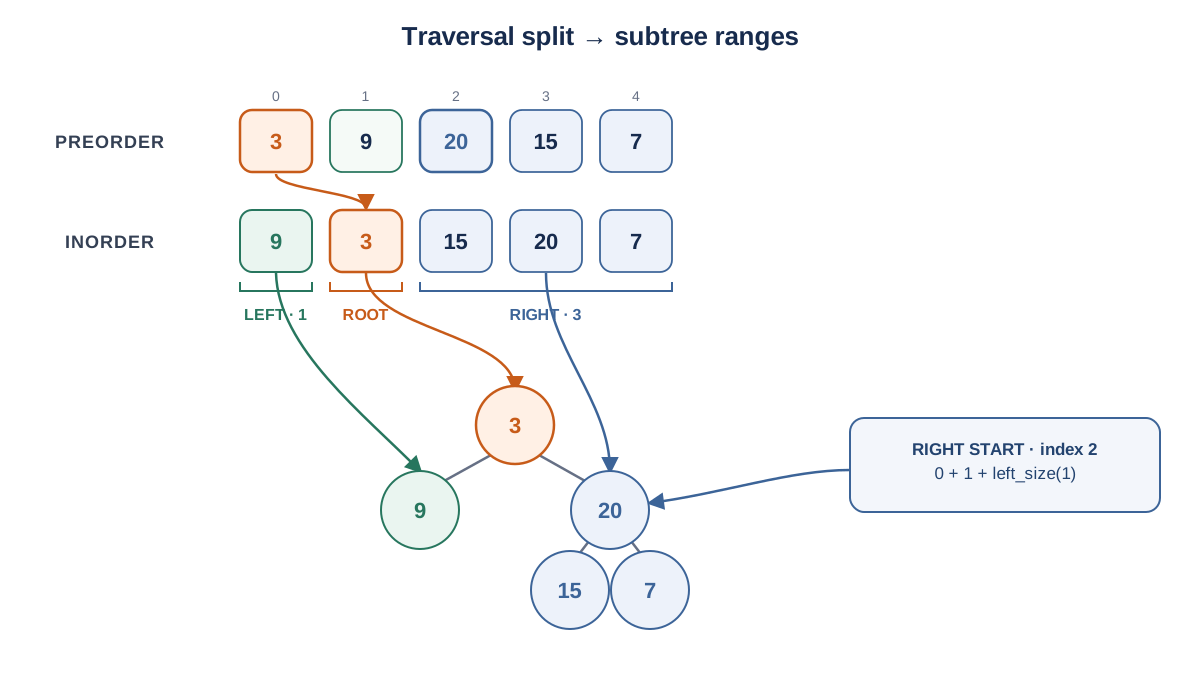
For any subtree, the first value in its preorder segment is its root.
Suppose a subtree uses this inorder interval:
[9, 3, 15, 20, 7]
Its root is 3. The index of 3 divides the interval:
left subtree  | root | right subtree
[9]           |  3   | [15, 20, 7]
The left subtree contains one node. That fact determines the preorder layout:
root | left subtree | right subtree
  3  |      9       |   20, 15, 7
The right subtree starts after:
- the current root:
1value - all nodes in the left subtree:
left_sizevalues
So if the current subtree starts at preorder index pre_start, the right subtree starts at:
pre_start + 1 + left_size
For the running example:
| Subtree | Root | Inorder interval | Left size | Right preorder start |
|---|---|---|---|---|
| Entire tree | 3 | [9, 3, 15, 20, 7] | 1 | 0 + 1 + 1 = 2 |
| Right subtree | 20 | [15, 20, 7] | 1 | 2 + 1 + 1 = 4 |
The important point is that the inorder index is a boundary, not a preorder offset. Mixing those two coordinate systems causes most off-by-one bugs.
Start with the brute-force version
A straightforward recursive solution can use inclusive inorder bounds:
build(pre_start, in_left, in_right)
At each call:
- Read
preorder[pre_start]as the root. - Scan
inorder[in_left:in_right + 1]to find that root. - Recursively build the left interval.
- Recursively build the right interval.
This version is useful because it exposes the structure clearly. Its bottleneck is the scan. In a skewed tree, the current subtree can contain almost every remaining node, and the next subtree can contain almost every remaining node again. The repeated scans add up to:
n + (n - 1) + (n - 2) + ... + 1 = O(n²)
The optimization is precise: build a value-to-index map for inorder once.
inorder_index = {value: index for index, value in enumerate(inorder)}
Then each root lookup is average-case O(1). Because values are unique, one index is enough for every value.
Define the recursive state and invariant
I prefer a helper with this state:
build(pre_start, in_start, size)
Its arguments mean:
pre_start: first index of this subtree inpreorderin_start: first index of this subtree ininordersize: number of nodes in this subtree
This representation avoids carrying two inclusive endpoints and makes the subtree size explicit.
The invariant
build(pre_start, in_start, size)returns the tree represented by the nextsizepreorder values beginning atpre_startand the nextsizeinorder values beginning atin_start.
That sentence is more valuable than memorizing the final formulas. It tells you what every recursive call must preserve.
For a nonempty subtree:
root_value = preorder[pre_start]
root_inorder_index = inorder_index[root_value]
left_size = root_inorder_index - in_start
Why does that subtraction work? The root is at root_inorder_index, and the subtree's inorder segment starts at in_start. Every value between those positions belongs to the left subtree.
Now derive the child states.
Left subtree
The left subtree:
- starts immediately after the root in preorder
- starts at
in_startin inorder - contains
left_sizenodes
build(pre_start + 1, in_start, left_size)
Right subtree
The right subtree:
- starts after the root and all left-subtree nodes in preorder
- starts immediately after the root in inorder
- contains
size - 1 - left_sizenodes
build(
    pre_start + 1 + left_size,
    root_inorder_index + 1,
    size - 1 - left_size
)
The base case is size == 0: there is no subtree, so return None.
This is divide and conquer with a clean contract. We split one valid subtree description into two smaller valid subtree descriptions, then attach their returned roots to the current root.
Why the construction is correct
The proof follows directly from the traversal definitions and the invariant.
Root correctness
In preorder, the first value of any subtree is its root. Therefore preorder[pre_start] is the correct root value for the current recursive call.
Partition correctness
In inorder, values before the root belong to the left subtree, and values after the root belong to the right subtree. The map gives the root's exact position, so:
left_size = root_inorder_index - in_start
is the number of left-subtree nodes.
Preorder alignment correctness
After the root, preorder lists the entire left subtree before listing any right-subtree node. Therefore:
- the left subtree begins at
pre_start + 1 - the right subtree begins after
1 + left_sizevalues
That gives the right start:
pre_start + 1 + left_size
Inductive conclusion
The recursive calls receive exactly the preorder and inorder segments belonging to their respective subtrees. Assuming the calls correctly construct smaller subtrees, attaching those results to the current root produces the required current subtree.
The recursion bottoms out when the segment has size zero. Since the input is guaranteed to contain valid matching traversals, the core solution does not need malformed-input handling.
Dry-run the index movement
Start with:
preorder = [3, 9, 20, 15, 7]
inorder  = [9, 3, 15, 20, 7]
The inorder index map is:
{
    9: 0,
    3: 1,
    15: 2,
    20: 3,
    7: 4
}
First call
build(pre_start=0, in_start=0, size=5)
- Root:
preorder[0] = 3 - Root index in inorder:
1 - Left size:
1 - 0 = 1 - Right size:
5 - 1 - 1 = 3
Recursive calls:
left:  build(pre_start=1, in_start=0, size=1)
right: build(pre_start=2, in_start=2, size=3)
The right preorder start is 2, not 1, because index 1 is occupied by the one-node left subtree.
Left call
build(pre_start=1, in_start=0, size=1)
- Root:
preorder[1] = 9 - Inorder position:
0 - Left size:
0
Both children have size zero, so this creates the leaf 9.
Right call
build(pre_start=2, in_start=2, size=3)
- Root:
preorder[2] = 20 - Inorder position:
3 - Left size:
3 - 2 = 1
Recursive calls:
left:  build(pre_start=3, in_start=2, size=1)  # node 15
right: build(pre_start=4, in_start=4, size=1)  # node 7
The final tree is therefore:
        3
       / \
      9   20
         /  \
        15   7
A useful skewed case is:
preorder = [1, 2, 3]
inorder  = [3, 2, 1]
Every root appears at the right edge of its inorder interval, so every left_size is size - 1 and every right subtree has size zero. The recursion follows only left children.
For a right-skewed tree:
preorder = [1, 2, 3]
inorder  = [1, 2, 3]
Every root appears at the left edge, so every left subtree has size zero and recursion follows only right children.
These cases are valuable because they expose both boundary behavior and maximum recursion depth.
Implement the Python solution cleanly
The platform usually provides TreeNode. The helper below keeps the preorder and inorder coordinates visible and avoids slicing:
from typing import List, Optional


class Solution:
    def buildTree(
        self,
        preorder: List[int],
        inorder: List[int],
    ) -> Optional["TreeNode"]:
        inorder_index = {
            value: index
            for index, value in enumerate(inorder)
        }

        def build(pre_start: int, in_start: int, size: int):
            if size == 0:
                return None

            root_value = preorder[pre_start]
            root_inorder_index = inorder_index[root_value]

            left_size = root_inorder_index - in_start
            right_size = size - 1 - left_size

            root = TreeNode(root_value)

            root.left = build(
                pre_start + 1,
                in_start,
                left_size,
            )

            root.right = build(
                pre_start + 1 + left_size,
                root_inorder_index + 1,
                right_size,
            )

            return root

        return build(0, 0, len(preorder))
Each variable has a specific obligation:
pre_startidentifies the current root in preorder.in_startidentifies the current inorder segment.sizeguarantees both segments describe the same number of nodes.root_inorder_indexfinds the structural split.left_sizedetermines both the left subtree size and the right subtree's preorder offset.right_sizeprevents the right recursion from consuming nodes outside the current subtree.
During an interview, I would perform a short code-reading pass in this order:
- Does
size == 0returnNone? - Is the root read from
preorder[pre_start]? - Is the inorder position found through the map?
- Is
left_sizemeasured relative toin_start? - Does the right preorder start skip both the root and the left subtree?
- Are both child results attached before returning the root?
That sequence catches the errors that examples often fail to expose.
Complexity, edge cases, and failure modes
Let n be the number of nodes.
Complexity
- Building the inorder map visits every value once:
O(n). - Each tree node is created once.
- Each map lookup takes average-case
O(1).
Therefore the total time complexity is:
O(n)
The map stores n entries, and the recursion stack can contain up to n calls for a completely skewed tree:
O(n) extra space
The balanced case uses a smaller recursion depth, but the worst-case stack remains linear.
Important edge cases
- Single node: both arrays contain one value. The helper creates one node and returns two empty children.
- Empty recursive interval: any call with
size == 0must returnNone. - Balanced tree: both child calls receive nonzero sizes.
- All-left tree: every right subtree has size zero.
- All-right tree: every left subtree has size zero.
- Unique values: the direct inorder map lookup is valid because each value has exactly one inorder position.
Common failure modes
Scanning inorder in every call.
This preserves the basic idea but can degrade to O(n²). If the interview asks for the linear-time solution, precompute the map.
Using the inorder index as a preorder offset.
The two arrays use different coordinate systems. The right subtree's preorder start depends on the number of nodes in the left subtree:
pre_start + 1 + left_size
It does not depend directly on root_inorder_index.
Slicing arrays at every recursion.
Slicing makes the code look compact, but it copies elements repeatedly and hides the segment boundaries. Use indices or sizes so the intended complexity remains visible.
Advancing a shared preorder pointer inconsistently.
A global pointer can work, but then its movement must follow the recursive preorder order exactly. The explicit pre_start state makes the alignment easier to inspect and debug.
Ignoring duplicate values in a different problem.
With duplicate values, a simple value-to-index map cannot identify which occurrence is the current root. This problem excludes duplicates, so the map-based solution is sufficient.
The transferable recognition rule is broader than this one tree problem:
When one representation reveals the next root or pivot, and another representation partitions the remaining elements around it, look for recursive interval decomposition.
Before coding, write the helper's segment invariant. Then derive the right-subtree offset from the left-subtree size. That small discipline turns a memorized formula into a construction you can reason about—and keeps one misplaced index from collapsing the whole tree.
References
Practice interview patterns more systematically
Use structured problem sets and pattern references to turn isolated solutions into reusable interview judgment.


